Showing posts with label History. Show all posts

Thursday, April 20, 2017

Quipu: The Alternative Language

Writing is a method of saving and transferring information in the form of symbols and numbers. When I first started singing my ABC's I had no idea what was the use of it. I knew that it was what the slightly older kids were doing in the school, singing songs and playing. So my eagerness to go to this "cool playing place" made me exhibit my ability to sing along. Sigh! Little did I know!


When I finally understood the purpose of alphabets, it amazed me that everything we say can be spelled out with those few letters. At first, I was a bit skeptical I decided to find the missing alphabets. Well! At least I tried ... I and my siblings, would sit and made gibberish noises and then try to spell those sounds. Every attempt was followed by giggles; it was a fun activity for us! Being bilingual, we had to try the same for the script of Hindi. However, I did not try this activity when I learned the script of Punjabi in fifth grade I assumed, as it was quite like Hindi, it will yield the same result.

As I grew a little bit older and had learned two lingual scripts, Hindi and English, I got obsessed with making my own language. Soon I realized it was a lot of work for a child, I had to put it aside and wait to grow up. Now that I am grown up, I am a bit busy with my project of world domination. Maybe after that, I would get on the pending job of coming up with my own language. So back in childhood, for the time being, for the purpose of having a secret language, I decided to assign numbers to alphabets and alphabets to numbers. In a way, I and my siblings had a coded secret language to leave messages for each other. Back then, we thought it was awesome! Of course, I wouldn't recommend it for some serious work as it was pretty easy to decipher.


When early human came up with scripts they had parallel symbols to represent objects and number. Those contrasting symbols evolved into alphabets and numbers respectively.They started with drawing objects that later turned into symbols via shorthand to save time. The purpose of writing was record keeping for the objects. The ancient people would draw the symbol of sheep and mark how many of those they have. It was a partial script they could not write plays and poetry with that. Language evolved out of that mode of record keeping. However, that was not the only mode of record keeping.


In the pre-Columbian Andes, they only used a partial script throughout their history. It was not suitable for writing stories; regardless those people were unfazed by its limitation. This partial script was very different from the written language. It was a method of saving information by knots on colourful chords. Those chords were called Quipus. They were made out of cotton or wool. Each quipu contained many chords and each chord contained knots at different places. There were variations in types of knots, colours, and locations of knots. 

Under Inka Empire, the Quipus kept the record of all the data of the empire. It was a pretty sophisticated system. It was so accurate that after the Spanish conquest of Inka Empire the Spaniards kept on using this system. However, Spaniards did not know how to read and record the quipu. They depended on the locals for the record keeping. So for the security of the new empire, they slowly eliminated the quipus and used written language. Thus, eventually the art of quipu died and the recording and deciphering died. Find more information on Quipu here.


Written Language is too intuitive for us that saving information in the form of symbols seems to be the only option. It is quite efficient too and works wonderfully. We code the same information in binary and make it more efficient to transfer. However, thinking that there could have been some other form of keeping manuscripts and records is entrancing.

It is fascinating to me that there were alternatives to writing! Can you think of any cool ways we could be had to communicate information like the ancient Inka did with knots? If so, let me know. 
Feel free to contribute your thought and opinions in the comment section


Thanks for visiting my Blog; it’s always good to see you here!
Find me on the following: Social Media


    Tuesday, April 18, 2017

    The Origin Of The Creator

    Language is one of the cornerstones of our human civilization. Animals, other than humans, have the ability to communicate via signals and sounds to alert and acknowledge their fellow beings. That kind of communication is sufficed to the survival of the organism. However, we humans don't merely survive. As we tend to have a more innovative set of skills and abilities. 

    Language is one of those skills that somehow evolved extensively in early human. The cognitive evolution of human mind gave early humans the ability to make up stories and tell stories. This was an upper-hand and offered them an opportunity to come together as a species.


    With the ability to exchange ideas and stories came along the stories about the creation and the creator. Language helped in forming stories about the origin of humans such stories helped building the society as we know it today. It can be debatable whether, without religion and creation stories, the course of human history would have been the same. The rise of human and his dominating the planet is a benefit of creation stories.

    Human children have relatively longer nurturing requirements. A human child needs years of parental involvement for food and protection. Under such circumstances, Humans are bound to be emotionally and psychologically attached to their parents. Thus the idea of creation centers a parent figure to humans collectively. The grander parental figures serve as a source of comfort and a sense of well-being. 

    This faith in the higher beings enforced a relation amongst human with the advent of culture and a state of law-ness. It transpired the state of authority over human actions. Thus, brings a state of cooperation amongst beings.  People believed in the same set of gods had a firm belief that 'someone' is keeping track of their actions and society turned more trusting towards each other. 


    The gaps in human knowledge were filled by the idea of gods controlling the world. If there was a natural calamity they knew whom to calm and pray to. The communities got bigger and organized; this strengthened the species against predators. It was because of the idea of God that early men organized thousands of individual in a single band. This association was the result of a firm and mutual belief in the same divine story. 

    This capacity of storytelling and basing the social organization on the same belief worked amazingly. In ancient days the polytheistic religion prevailed. This added the benefit of inclusion of more and more people together by acknowledging each other's Gods. This is a thing Romans were known to be doing. They included the local Gods of the conquered areas into their own Gods.  This accommodation could not work with monotheistic belief.  With the passage of time rise of monotheism replaced the polytheistic with Constantine's conversion to monotheistic Christianity and dilution of paganism. That led to a new era of the God. Today our world is predominantly monotheistic. 


    The oldest surviving religion, Hinduism, have traversed into a monotheistic origin of various Gods and Goddesses. To me, the ardent survival of it is quite fascinating. The flexibility and ability to reform have been the key to bolstering its own self. Ahem Ahem! * Looking at you the contemporary Hindutva agenda.* 

    History is evident that, as the time passes the idea of God/Gods are bound to alter. Thinking that it will remain as it is, is a myopic point of view. It will change into something that is more suitable as per the need of time. 

    Any theories on how the world's religion will be in 2000 years? Assuming, the human race will survive the imminent climate change. Let me know your thought in the comment section below.


    Thanks for visiting my Blog; it’s always good to see you here!
    Find me on the following: Social Media


    Tuesday, April 4, 2017

    My Cognitive Dissonance With Clockwise.

    I have the strangest habit of imagining walking in a place I visit often or have had visited in past. It is almost like a thought simulation running in the backdrop of my consciousness. If I am talking to you over the phone Or performing a task that doesn't require much attention,  an unconscious section in my brain is wandering in a physical location. Taking turns on random streets randomly walking in a pre-visited destination. It's like an unconscious simulation going on in this weird section of my brain. I have spotted my mind randomly in very specific locations and destination. Ugh! I frankly don't know what it is, but my mind has a kind of obsession with places. I am not even sure if other people do that!


    Perhaps that is why I often find myself studying maps of locations, that I have been to, on Google earth. Just to get a clearer picture of neighborhoods so when I unconsciously stroll around in those streets in my imagination I know where exactly I am. Sometimes I like to zoom out to the map of the city or country and imagine/observe the mental simulation from distance. It is all just fun and games, a smooth distraction for my brain in not-so-engaging times until I zoom it out to a far reach. To an extent when my imagination is hovering over the north pole of Earth and I can picture the Earth spinning anti-clockwise.


    I personally find it very uncomfortable, as if something is wrong with the spin. So one time, I was in my mind hovering over our lonely little Earth and was absorbed in this eerie feeling of distorted discomfort over the direction of Earth's spin from the north pole. I wanted to get to the bottom of it Why does it bother me that the earth is spinning anti-clockwise from the given position? I introspected and came to a conclusion.


    The way I learned to decipher a map or globe is north is alway the top and that in my mind should be the reference point or standardize the point-of-view. Nevertheless,  I perceive the forward direction of time as clockwise from the standard analog clocks. Thus, When I imagine my standard reference position and don't find it in accordance with the positive direction of time my brain lands me in a dissonance. I may be the only one to find my mind roam around, but I can't be the only one to adopt this line of thinking, namely taking north as top and clockwise as forwarding in the direction of time. Perhaps If we were taught the maps upside down as a standard reference or We had the clocks running anticlockwise I may haven't had found myself in this disharmony.

    So, Why are maps north up? Ancient maps were mostly drawn to the standard of the East on top because the Sun rises from the East and that represents a start. The paradigm shift of contemporary standard maps can't be pointed out on the calendar. It seems that this model was gradually adopted as standard. More likely it is as per the standers of right-hand thumb rule this seems to co-ordinate with the rest of the representative standards. The rotation of the Earth is counter-clockwise, so if we curl our right hand's fingers in counterclockwise fashion the direction our thumbs will be pointing shall be taken as the top. So it makes sense...

    Hence the discrepancy lies in the way clocks run. Why were the clocks designed in a 'clockwise' direction? Clocks could run perfectly in the anticlockwise direction. Heck! we define the spin direction from a man-made object. It is like the clocks are the forerunner of the standard of spinning. I find it really fascinating!


    Why do we have clocks running in the clockwise direction? The analog clock models were based on the sundial. Sundial is basically an ancient way of keeping track of the time during the day.  Due to the movement of the earth throughout the day, the sun appears to move from east to west on earth. This apparent moment of Sun changes the position of shadows. The sundials use this property, it consists of a flat plate (A dial) and a gnomon (Part that casts the shadow) As the position of the sun changes the shadow changes. Sundials can be dated back to 3000 years and were independently used in most major civilization.


    However, this doesn't resolve the clockwise and anti-clockwise issue I had. As the sundial possess duality depending on which hemisphere you live on. In the northern hemisphere, the direction of the shadow cast by sundial moves in the clockwise fashion and in the southern hemisphere, it moves in the counter clockwise fashion. Thus the sundials run counterclockwise in the southern hemisphere.


    The answer lies in the location where the clocks were designed. Our modern day analog clock was designed in China in 725 AD by Yi Xing, north hemispher. The makers just simply replicated the motion of shadow on the sundial. It was the only rational thing to do from the standpoint of knowledge of that era. That direction became clockwise. Isn't it peculiar that if the clocks were first designed in the southern hemisphere our idea of clockwise and anti-clockwise would have been the absolute opposite! Possibly in some parallel universe, the clock on your wall is ticking in our respective counter-clockwise direction.


    In fact, there are some clocks made in Arabic and Hebrew notations that actually run counterclockwise. Simply because the scripts in the Arabic and Hebrew are from right to left, unlike most of the scripts. Despite the natives lands of those two languages are in the northern hemisphere, the clocks are made to accommodate the opposite direction of written scripts. 

    What is your opinion on the topic if this blog? Do you have any strange quirky habits or some activities in the backdrop of your mind too? Comment down below and let me know.


    Sunday, April 2, 2017

    Alexandria: The Muser's Hub

    If you ask me where would I like to go if I could time travel I would instantly reply to Roman or Greek Empire in the peak of their glory. However, on a second thought, I may take my words back and say "Meh! I am good here in 2017. It is a pretty good time to be a woman and commoner."


    Recently I was reading Oedipus Rex by Sophocles. And reading such fine ancient play always takes me back to the library of Alexandria. The event in the ancient history, that I reckon to be most detrimental for human civilization, was the burning of The library of Alexandria in  48 BC and its further obliteration in 642 AD.


    The Royal library of Alexandria was one of the most notable libraries of the ancient times. It was a part of the think tank based in Alexandria called the Museum of Alexandria. The Museum was founded and patronaged by the Ptolemaic dynasty in the 300 BC.  It was dedicated to Alexander the great by his right-hand man Ptolemy. The museum was the forerunner of our present day research institutes. A university where scholars from distant lands went to further their study in all sorts of subjects. Museum- a place to muse where philosophers and thinkers gathered and did the thinking and exchanged the ideas. Unlike what we now know to be a museum, a place to display ancient artifacts. The current usage of the word museum was first spotted on in the 1600s. In ancient times Museum was a thinking place.  The royal Museum was also referred as Temple of muses that included idols of pagan Gods. I stress the word "Gods", the polytheistic, good old fashioned Gods because it is kind of a reflection to why we don't have this library today. #Cringe 


    The city of Alexandria was situated on a harbor with the most glorious lighthouse of past one of the seven wonders of its time.The traders sailing through the Mediterranean often stopped at this Port. The marines who came to the port were often searched for drugs, did I say drugs? No! books, they searched the sailors and passer-by for the BOOKS. Such was the passion of the Ptolemaic dynasty towards collecting scripts. When the Books (scrolls) were found, they were confiscated and the person carrying books was compensated for the text. The books were then sent to the collection to the library of Alexandria. Alexandria was the hub for its vast collection of information pretty much like our internet. If there was any written material Alexandria probably had a copy of it.

    No one knows what was the extent of the collection in the library, but many people believe that its destruction probably threw humanity a century behind in its course for the pursuit of knowledge. One of the most revolutionary inventions was the invention of the Steam Engine in the late 1700s. It changed the course of the human race, as they knew it at that time. In the museum of Alexandria in ancient Egypt scholars such as  Archimedes, Vitruvius, Heron ho Alexandreus, Hypatia and Ctesibius (and many others) were enrolled. Many of them were working on harnessing the energy from steam and wind. One such example is Aeolipile a precursor of the steam engine by Heron. Arguably, the purpose of getting machine power to eliminate human labor may not be the motivation of the engineers of Alexandria ... after all slaves were there to do that! It may have taken humanity some time to up its game on human rights, but regardless the work was in its nascent stage and would have been eventually put to application had the library of Alexandria not been destroyed.


    The destruction of the library is often attributed to multiple instants and is disputed over by historians, but one thing is certain the library was completely eliminated by 642 AD. It is not known which of these events is responsible for destroying the library to what degree. However, majorly four recorded events are held responsible for it altogether.


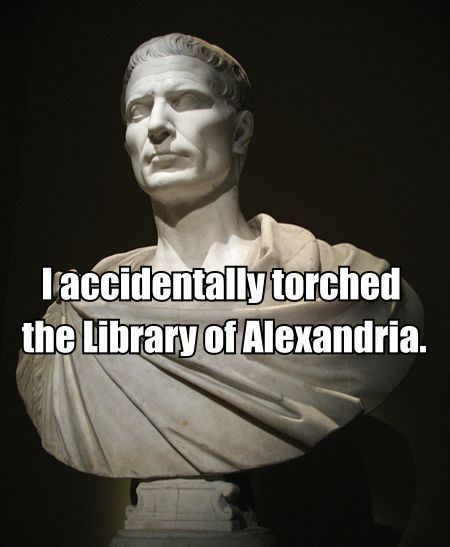
    The first destruction is on the hand's Roman republic during the siege of Alexandria in 48 BC.  Julia Caesar burned his own ships to distract his enemy and the fire started by Caesar's soldiers went astray and burned down a section of the library.  It was still not completely destroyed as Alexandria was still the scholar's hub during the time of Augustus of Roman Empire.


    The second destruction was an attack on the Alexandria by the Aurelian in the 270 AD, during the fighting of this era the area where the library was situated was destroyed some of the content of the library may have been destroyed.

    The third destruction was the order of the Pope/ Emperor Theodosius in 415 AD, under his reign Paganism was made illegal in Rome. During this time the empire was rioting. Every temple was shut down or destroyed by mobs. It was during one of those days when Hypatia, a female Mathematician of Alexandria, was murdered by the mob. After her death, the museum of Alexandria along with the temple was sacked the library was rampaged in the riots.


    Lastly, the destruction or the annihilation of whatever was left of the scrolls and books is attributed to the Islamic caliphate of second Caliph Omar/Umar in 642 AD under the command of Amr ibn Al-As during the Muslim conquest of Egypt the fate of library was put to the hands of Caliph by Amr the commander of Arab army. He wrote to the caliph and received a reply (and I quote). ”If those books are in agreement with the Quran, we have no need of them; and if these are opposed to the Quran, destroy them."

    Even if we could not technically advance as a civilization in spite of the great library. As a book nerd, I still would have cherished the ancient plays and literature that is lost in the time. How do you think humanity would have been had we still had the library in its ancient form intact? Comment Down below. Let us muse here in this comment section in memory of The Library of Alexandria.


    Find me on the following; #SocialMedia
    PS. I understand that the last destruction by the Caliph is often controversial (Most of them are as I mentioned in the post.) I have provided the link to the sources in that section. The mentioned quote is there on the Wikipedia as well. Moreover, I think I must include this Islamic site that infers more or less the same narration. Please click here to reach the site. This link is already included in the given site so I didn't worry to add while writing but in light of providing the source I must include it as well.