Showing posts with label Book Nerd. Show all posts

Tuesday, April 4, 2017

My Cognitive Dissonance With Clockwise.

I have the strangest habit of imagining walking in a place I visit often or have had visited in past. It is almost like a thought simulation running in the backdrop of my consciousness. If I am talking to you over the phone Or performing a task that doesn't require much attention,  an unconscious section in my brain is wandering in a physical location. Taking turns on random streets randomly walking in a pre-visited destination. It's like an unconscious simulation going on in this weird section of my brain. I have spotted my mind randomly in very specific locations and destination. Ugh! I frankly don't know what it is, but my mind has a kind of obsession with places. I am not even sure if other people do that!


Perhaps that is why I often find myself studying maps of locations, that I have been to, on Google earth. Just to get a clearer picture of neighborhoods so when I unconsciously stroll around in those streets in my imagination I know where exactly I am. Sometimes I like to zoom out to the map of the city or country and imagine/observe the mental simulation from distance. It is all just fun and games, a smooth distraction for my brain in not-so-engaging times until I zoom it out to a far reach. To an extent when my imagination is hovering over the north pole of Earth and I can picture the Earth spinning anti-clockwise.


I personally find it very uncomfortable, as if something is wrong with the spin. So one time, I was in my mind hovering over our lonely little Earth and was absorbed in this eerie feeling of distorted discomfort over the direction of Earth's spin from the north pole. I wanted to get to the bottom of it Why does it bother me that the earth is spinning anti-clockwise from the given position? I introspected and came to a conclusion.


The way I learned to decipher a map or globe is north is alway the top and that in my mind should be the reference point or standardize the point-of-view. Nevertheless,  I perceive the forward direction of time as clockwise from the standard analog clocks. Thus, When I imagine my standard reference position and don't find it in accordance with the positive direction of time my brain lands me in a dissonance. I may be the only one to find my mind roam around, but I can't be the only one to adopt this line of thinking, namely taking north as top and clockwise as forwarding in the direction of time. Perhaps If we were taught the maps upside down as a standard reference or We had the clocks running anticlockwise I may haven't had found myself in this disharmony.

So, Why are maps north up? Ancient maps were mostly drawn to the standard of the East on top because the Sun rises from the East and that represents a start. The paradigm shift of contemporary standard maps can't be pointed out on the calendar. It seems that this model was gradually adopted as standard. More likely it is as per the standers of right-hand thumb rule this seems to co-ordinate with the rest of the representative standards. The rotation of the Earth is counter-clockwise, so if we curl our right hand's fingers in counterclockwise fashion the direction our thumbs will be pointing shall be taken as the top. So it makes sense...

Hence the discrepancy lies in the way clocks run. Why were the clocks designed in a 'clockwise' direction? Clocks could run perfectly in the anticlockwise direction. Heck! we define the spin direction from a man-made object. It is like the clocks are the forerunner of the standard of spinning. I find it really fascinating!


Why do we have clocks running in the clockwise direction? The analog clock models were based on the sundial. Sundial is basically an ancient way of keeping track of the time during the day.  Due to the movement of the earth throughout the day, the sun appears to move from east to west on earth. This apparent moment of Sun changes the position of shadows. The sundials use this property, it consists of a flat plate (A dial) and a gnomon (Part that casts the shadow) As the position of the sun changes the shadow changes. Sundials can be dated back to 3000 years and were independently used in most major civilization.


However, this doesn't resolve the clockwise and anti-clockwise issue I had. As the sundial possess duality depending on which hemisphere you live on. In the northern hemisphere, the direction of the shadow cast by sundial moves in the clockwise fashion and in the southern hemisphere, it moves in the counter clockwise fashion. Thus the sundials run counterclockwise in the southern hemisphere.


The answer lies in the location where the clocks were designed. Our modern day analog clock was designed in China in 725 AD by Yi Xing, north hemispher. The makers just simply replicated the motion of shadow on the sundial. It was the only rational thing to do from the standpoint of knowledge of that era. That direction became clockwise. Isn't it peculiar that if the clocks were first designed in the southern hemisphere our idea of clockwise and anti-clockwise would have been the absolute opposite! Possibly in some parallel universe, the clock on your wall is ticking in our respective counter-clockwise direction.


In fact, there are some clocks made in Arabic and Hebrew notations that actually run counterclockwise. Simply because the scripts in the Arabic and Hebrew are from right to left, unlike most of the scripts. Despite the natives lands of those two languages are in the northern hemisphere, the clocks are made to accommodate the opposite direction of written scripts. 

What is your opinion on the topic if this blog? Do you have any strange quirky habits or some activities in the backdrop of your mind too? Comment down below and let me know.


Sunday, April 2, 2017

Alexandria: The Muser's Hub

If you ask me where would I like to go if I could time travel I would instantly reply to Roman or Greek Empire in the peak of their glory. However, on a second thought, I may take my words back and say "Meh! I am good here in 2017. It is a pretty good time to be a woman and commoner."


Recently I was reading Oedipus Rex by Sophocles. And reading such fine ancient play always takes me back to the library of Alexandria. The event in the ancient history, that I reckon to be most detrimental for human civilization, was the burning of The library of Alexandria in  48 BC and its further obliteration in 642 AD.


The Royal library of Alexandria was one of the most notable libraries of the ancient times. It was a part of the think tank based in Alexandria called the Museum of Alexandria. The Museum was founded and patronaged by the Ptolemaic dynasty in the 300 BC.  It was dedicated to Alexander the great by his right-hand man Ptolemy. The museum was the forerunner of our present day research institutes. A university where scholars from distant lands went to further their study in all sorts of subjects. Museum- a place to muse where philosophers and thinkers gathered and did the thinking and exchanged the ideas. Unlike what we now know to be a museum, a place to display ancient artifacts. The current usage of the word museum was first spotted on in the 1600s. In ancient times Museum was a thinking place.  The royal Museum was also referred as Temple of muses that included idols of pagan Gods. I stress the word "Gods", the polytheistic, good old fashioned Gods because it is kind of a reflection to why we don't have this library today. #Cringe 


The city of Alexandria was situated on a harbor with the most glorious lighthouse of past one of the seven wonders of its time.The traders sailing through the Mediterranean often stopped at this Port. The marines who came to the port were often searched for drugs, did I say drugs? No! books, they searched the sailors and passer-by for the BOOKS. Such was the passion of the Ptolemaic dynasty towards collecting scripts. When the Books (scrolls) were found, they were confiscated and the person carrying books was compensated for the text. The books were then sent to the collection to the library of Alexandria. Alexandria was the hub for its vast collection of information pretty much like our internet. If there was any written material Alexandria probably had a copy of it.

No one knows what was the extent of the collection in the library, but many people believe that its destruction probably threw humanity a century behind in its course for the pursuit of knowledge. One of the most revolutionary inventions was the invention of the Steam Engine in the late 1700s. It changed the course of the human race, as they knew it at that time. In the museum of Alexandria in ancient Egypt scholars such as  Archimedes, Vitruvius, Heron ho Alexandreus, Hypatia and Ctesibius (and many others) were enrolled. Many of them were working on harnessing the energy from steam and wind. One such example is Aeolipile a precursor of the steam engine by Heron. Arguably, the purpose of getting machine power to eliminate human labor may not be the motivation of the engineers of Alexandria ... after all slaves were there to do that! It may have taken humanity some time to up its game on human rights, but regardless the work was in its nascent stage and would have been eventually put to application had the library of Alexandria not been destroyed.


The destruction of the library is often attributed to multiple instants and is disputed over by historians, but one thing is certain the library was completely eliminated by 642 AD. It is not known which of these events is responsible for destroying the library to what degree. However, majorly four recorded events are held responsible for it altogether.


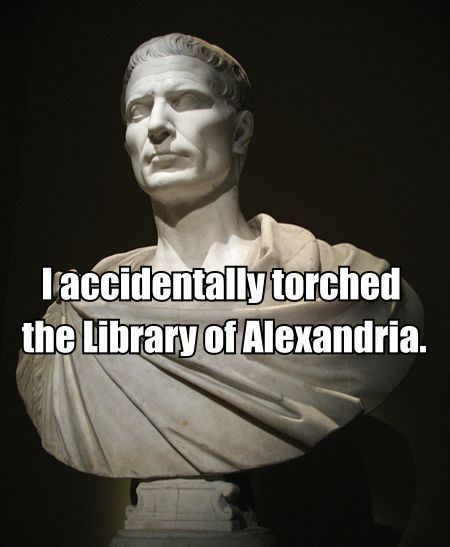
The first destruction is on the hand's Roman republic during the siege of Alexandria in 48 BC.  Julia Caesar burned his own ships to distract his enemy and the fire started by Caesar's soldiers went astray and burned down a section of the library.  It was still not completely destroyed as Alexandria was still the scholar's hub during the time of Augustus of Roman Empire.


The second destruction was an attack on the Alexandria by the Aurelian in the 270 AD, during the fighting of this era the area where the library was situated was destroyed some of the content of the library may have been destroyed.

The third destruction was the order of the Pope/ Emperor Theodosius in 415 AD, under his reign Paganism was made illegal in Rome. During this time the empire was rioting. Every temple was shut down or destroyed by mobs. It was during one of those days when Hypatia, a female Mathematician of Alexandria, was murdered by the mob. After her death, the museum of Alexandria along with the temple was sacked the library was rampaged in the riots.


Lastly, the destruction or the annihilation of whatever was left of the scrolls and books is attributed to the Islamic caliphate of second Caliph Omar/Umar in 642 AD under the command of Amr ibn Al-As during the Muslim conquest of Egypt the fate of library was put to the hands of Caliph by Amr the commander of Arab army. He wrote to the caliph and received a reply (and I quote). ”If those books are in agreement with the Quran, we have no need of them; and if these are opposed to the Quran, destroy them."

Even if we could not technically advance as a civilization in spite of the great library. As a book nerd, I still would have cherished the ancient plays and literature that is lost in the time. How do you think humanity would have been had we still had the library in its ancient form intact? Comment Down below. Let us muse here in this comment section in memory of The Library of Alexandria.


Find me on the following; #SocialMedia
PS. I understand that the last destruction by the Caliph is often controversial (Most of them are as I mentioned in the post.) I have provided the link to the sources in that section. The mentioned quote is there on the Wikipedia as well. Moreover, I think I must include this Islamic site that infers more or less the same narration. Please click here to reach the site. This link is already included in the given site so I didn't worry to add while writing but in light of providing the source I must include it as well. 

Wednesday, January 18, 2017

My First Expedition


I was a little girl in early 1990s, as most of the females are at some point in their life ... I was terrified of the dark. I couldn't walk past the veranda of my grandparent's house without being accompanied by an adult during night time. Clutching the big adult hand with my little hands, sometimes my nails dabbed with nail enamel if I was lucky enough to convince my Mum to let me try it. Darkness was dreadful to me in that era, so were Cats, darkness signified to me that some monster is lurking in it to get me. Well, err my prime concern was not just the villainous monsters but also the great God above.


I remember those religious/ mythological shows on telly that implied that God was watching every action from above the clouds and commenting about stuff to his female companion. They, God and his lady, were mostly teasing each other in their cloud living room with a gaudy furnishing and a serpent couch. On a second thought, I liked the furnishing and the dresses and the tiaras ... I remember not being able to understand the premise of the show or what was going on in the show. All I knew was that at some points God often formed stairs of clouds (well-decorated stairs with carpet!) and walked down the stairs stunned the mortal he was watching over and made him so happy and fortunate. Sometimes the cloud stair was replaced by smoke! And puff! Came the God guy or Goddess lady. Or seldom the lightning in the sky ... and God yelling at the corrupt mortal, from the clouds in a hologram form. So I was convinced that it was the casual way of  God's conversing with us mortals. Being a young mortal myself it terrified me.

I didn't want God to startle me with his ways I was just not ready for that kind of excitement. I often prayed to God "Please don't show up! Please don't show up!" ... I never told the grown-ups about my concern related to God showing up, but I asked them, how will they feel if God came to them. The Grown-ups often seemed indifferent and/or unconcern by the matter. Thus I never showed my weakness by telling them that it was scary to me. I was a big and strong girl! duh!


One person who wanted me to be unafraid of the dark was my Grandpa. Now, as an adult, I like darker and quieter time of the day the most. I often think about the time when he would help me practice facing my fears. On the windy and soothing nights of the 1990s, after we had dinner my grandpa use to take me to the veranda and tell me, patiently, how it was all the same as daytime. He would explain to me, our veranda was still the same the other end led to the little garden with flowers, where I played in evening. I image of that garden is still so fresh in my mind, the beautiful Hibiscus, Rangoon Creeper, Golden trumpet and some occasional roses and tiny white flowers with strong fragrance. There was a black and white Gate next to the garden. I swung on that gate every evening... My Grandpa eventually convinced me of the fact that it was all the same just with no light to help us see. After a few days of this routine of explaining, he asked me do I want to test it? After a little reluctance, I agreed and I was set on the biggest adventure of my life till that day. I was to go and touch the trunk of the Hibiscus tree, all by myself, in the dark of night. I did it and while I was running in the veranda towards the tree and back, all the while my grandpa's voice from the other side of the veranda was comforting me. "I am right here, it is all the same as it is in the evening..." I ran back to him after touching the tree and being assured that it was same in the dark only I couldn't see it. I swear I felt a little bit grown-up that day.


As for the telly shows on mythology were concerned, I was soon barred from watching them as I cried my heart out after watching an episode in witch, a woman drowned her newborn baby in a river. What Evil! I had a little baby sister and babies meant my little sister, whom I loved so much. Yup, I was one of those siblings who love their younger siblings and never feel a hint of jealousy towards the new member. I kid you not that is a rare thing and it is kind of a window to the future relationship of the siblings in question.

I didn't mind being barred from that Sunday Morning Doordarshan's mythological show, that was the best thing that happened to me! I was busy stealing milk powder and Bon-vita from the kitchen while adults were occupied with their "Main samay hun!" telly show!


Find me on the following; #SocialMedia

Thursday, April 14, 2016

Literature

I love to read, it brings me the pleasure and upliftment that I cannot express in words. To articulate it in the terms of literary work I would say:

“My thoughts are stars I cannot fathom into constellations.”
~ John Green, The Fault in Our Stars


I like reading for many reasons and one of it is being "teleported" to another world and time. To read the written words of some men and women that I could never possibly have come across due to constraints of unidirectional time. I can never go back in time to have a conversation with Kurt Vonnegut or can I? Well, theoretically I can! But, since time travel is not a thing, yet. The constraint according to the current understanding of physics is,  I can only travel back to the time when the time machine would be invented and not before that... that's another topic for another blog. Also, we haven't yet figured out how tenses would work in the era of time-travel so if we get to travel in time, literature would also need to be upgraded in order to incorporate a more clear understanding of the "directional" time.

The Need of Literature
Writing and Reading are the fundamental labels of civilization. It was a product of the desire to use words to communicate complicated ideas amongst people. Reading is about compassion, it is an act when we imagine; what it would be like to be someone else in a certain situation. It is not easy to express what one is feeling through words. However, reading could give us the tools to express and write what we precisely want to convey. It is a kind of an iteration process, the more we read the more we know about other people's feeling and about our own.


Experience and Empathy
The beauty of literature is that it gives one a way to gain an understanding of complex ideas and emotions. The emotions and feelings that may have taken decays if were left alone to be understood via experience. Reading can take us to infinite kind situations such as famine, war, murder, romance, and breakups. Some situations that we may not experience in life directly. With the access to reading, we can experience. That in turn, helps us gaining a sense of empathy towards friends and family in a similar situation. 


The Consequences of Actions
Literature makes one empathetic by making us see the consequences of actions in the long run, over a shorter time span.  One can read a "coming out of age" novel and understand how certain small things can form a whole identity/personality trait. It shows us the bigger picture of rather smaller actions. It makes one see others as people, who are capable of similar feeling and emotions as ourselves. Thus makes us kinder and sympathetic about what they are going through. 


My Reading Habits
I was hooked on to reading by Nacy Drew and Harry Potter. It has been an amazing experience so far. I had no one to guide me through the books that I should read. So I kind of improvised and today I am at a place where I know what kind of literature I will enjoy reading. However, Picking a favorite book or genre is always perplexing. It is pretty much like picking up your favorite child. I often answer that question with "one of" my favorite books. But, you see it is not that easy.

The Dilemma of Genre 
In the recent past, there has been a heated debate that Young Adult (YA) genre in literature is... umm, How do I put it.. "not good enough". That debate bashes the adults reading YA genre. I think that YA  is intended for teens and has many topics revolving around the life of teens (and people in their early 20s). But, if as an adult one is exclusively reading the contemporary YA it is not such a good option. There is no problem with reading YA but the exclusivity of it is akin to looking at just one side or section of literature. I would suggest mixing it up a little with some classics. 

That said, I often find Young Adult genre engaging and pleasurable. It is often designed to introduce and engage people in literature. There are numbers of contemporary YA fiction that are really good, such as Hunger Games. But some are terrible like that Vampire Stories. However, I find many YA books off-putting for reasons such as:
Romanticization of unhealthy relationships

Dumbing Down assuming the readers to be lowbrowed, thus using easy vocab.
Not being intellectually stimulating
Slut shaming 
The portray of the same personalities of the protagonist 
Unrealistic representation of Teenagers ...


This month I have been a little picky to read as I couldn't find any book stimulating or engaging enough. However, I think it is a matter of time. I will find a good book or may regain interest in the pile of half-read abandoned books. Let me know what you like reading and what is your take on literature. 


Find me on the following; #SocialMedia

Monday, April 4, 2016

Cover Of Books: Case Study


We often hear in conversations "Don't judge a book by its cover". Metaphorically it intends to say "you shouldn't prejudge the worth or value of something, by its outward appearance alone". If taken metaphorically, It is a very good advice.However, is it true literally too?


Apparent origin of this Phase goes back to Piqua Democrat, June 1867: "Don't judge a book by its cover, see a man by his cloth, as there is often a good deal of solid worth and superior skill underneath a jacket and yaller pants."


Sure, A cover is an exhibit but, covers are deliberately designed to give a showcase to the content. It is intending to guide you to your next favorite book. I admit more than often it  fails to do the trick


There goes in a lot of work into designing a perfect cover for books. The cover is one of the major players in the marketing strategy of a book. Attracting the target readers and drawing attention is crucial for a book's success. From layout, typography, image and color everything is deliberately decided.


Further, in this post, I will analyze some book covers. If you are spoiler sensitive, I  would take this opportunity to inform you that it may contain spoilers.


The Catcher in The Rye by J.D. Salinger


On a closer look, the cover tells a lot about content. This cover has a rather, plain typography and a quaint color scheme. It is aesthetically pleasing and looks even better as the book ages. My copy of The Cather in Rye had another cover. However, this cover bewildered me. Initially,  I was presuming it to be a depiction of Horse from the advertisement of "Pencey Prep". I wondered where was the "hotshot guy on a horse" as mentioned in the book. I couldn't understand. Then after looking closely, I realized it is a Carrousel. J.D.Salinger does it again, subliminal symbolism. Carrousel in this book represents Holden's (The protagonist) "Happy Place".  The Cover is limning the part in the book where Holden looks at the Carrousel and narrates. 

"Then the carousel started ... All the kids kept trying to grab for the gold ring, and so was old Phoebe, and I was sort of afraid she'd fall off the goddam horse, but I didn't say anything or do anything. The thing with kids is, if they want to grab the gold ring, you have to let them do it, and not say anything. If they fall off they fall off, but it's bad if you say anything to them."

The cover depicts the moment of one of the literature's iconic denouement. As the narration proceeds, Holden expresses his feelings.

"I was damn near bawling, I felt so damn happy if you want to know the truth. I don't know why. It was just that she looked so damn nice, the way she kept going around and around, in her blue coat and all. God, I wish you could've been there." 

Holden wishes the readers could be there and the cover of the book indeed attempts to take us there... Isn't it a beautiful idea?


This cover is peculiar. It breaks all the conventions of cover design, yet ironically fits perfectly within the Idea of the book. The book revolves around the theme of misfits, what could be a better approach to emphasize it then an uneven typography. There is no capitalization in the cover indicating naive approach yet, it is innocuous. It gives away a sense that the Initials are trying to blend in the words that follow. To me, it strongly indicates confused and unformed ideas. Something that is as nascent as a first-draft, #young. 

The protagonist in this book is a Wallflower: a person who from shyness or unpopularity remains on the sidelines of a social activity (as a dance). This cover personifies this definition. While the background is flashy green, subject/ imagery is dull and sided. Pretty much like Charlie's (Protagonist) character preferred to be. In a similar way, the sided image is yet more complicated and profound than the flashy green background. Charlie, in the book, has a knack to analyze things from a unique point of view, this is very thoughtfully indicated on the cover. 


The picture selected is also very interesting, Old-timey and soft color scheme displaying a young boy. The lack of a face is interesting as it makes one curious, yet the pose expresses young adult-ish disquiet.  It indicates, yet not explicitly, that sexuality is to be exploration. Moreover, the frame of indicated sexuality is rather slavish and scary. 


Lastly, I will discuss the dilemma of designing the cover of Lolita by Vladimir Nabokov. There have been numerous covers of the same, many of which puts Lolita in an explicitly sexualized way. Which is unfair to project as it validifies Humbert's opinion on lolita being corrupt, but is not evident to be true.  Humbert is the notoriously unreliable narrator and the novel gives a little narrative of what Lolita is personally like. The way Humbert's prose sells a sexual image of lolita is brilliant but his motive is to free himself from the judging eyes of the readers.


This design problem is explored in a book Lolita: The Story of a Cover Girl. Out of many covers designed so far (some brilliant and others corny) 


I have Included few covers that I like in this post.These covers look innocent yet reflect the sexual nature of the book in a subliminal manner. That I find smart as a whip. 


To read the rules employed in a book cover design visit here.


Find me on the following; #SocialMedia 
Twitter 
Instagram 
Goodreads 
Tumblr